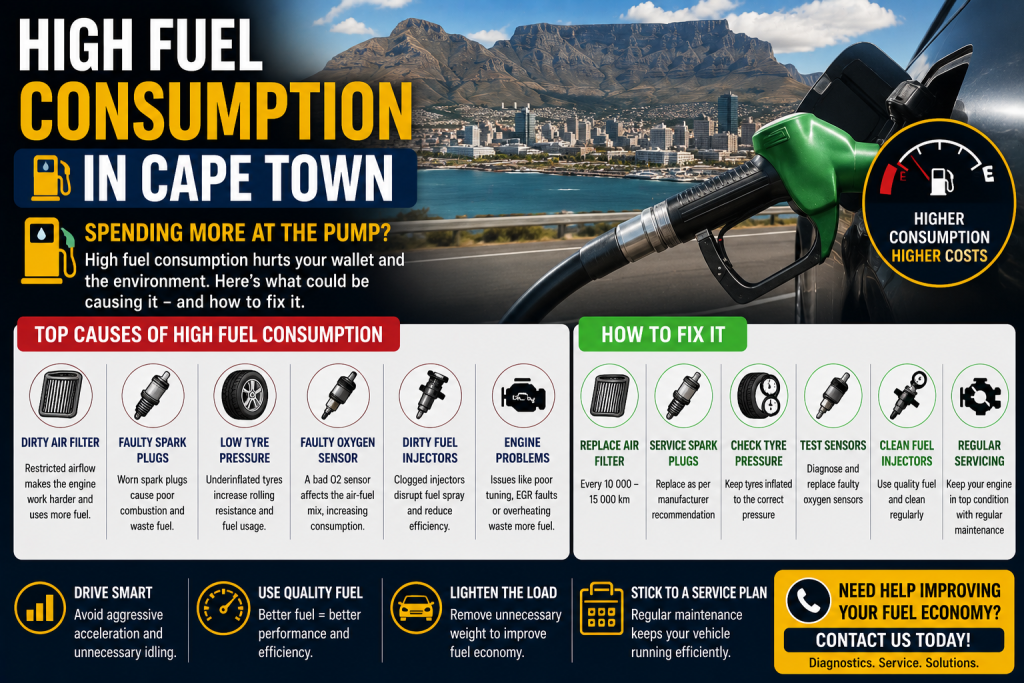
High Fuel Consumption in Cape Town – Causes & How To Fix It
If your vehicle is suddenly using more fuel than usual, there is usually a reason behind it. Poor fuel economy can be caused by servicing issues, sensor faults, fuel system problems, tyre pressure, driving conditions, or engine performance faults.
High fuel consumption is one of the most common complaints from Cape Town drivers. Fuel prices are already expensive, so when a vehicle starts using more petrol or diesel than normal, the problem quickly affects your monthly budget. However, poor fuel economy is not always caused by the way you drive. In many cases, the vehicle itself is not running efficiently.
Your engine needs the correct balance of air, fuel, spark, compression, and timing to run properly. When one of those systems is not working as it should, the engine may burn more fuel to compensate. That can lead to fewer kilometres per tank, rough idling, poor acceleration, black smoke, strong fuel smells, or even warning lights on the dashboard.
At Cape Town Mobile Mechanic, we help drivers identify the real reason their car is using too much fuel. Instead of guessing and replacing random parts, we check the vehicle properly so the root cause can be fixed.
What Counts as High Fuel Consumption?
Every vehicle has a normal fuel consumption range. A small hatchback should not use the same amount of fuel as a large SUV, and a diesel bakkie will behave differently from a petrol sedan. However, the warning sign is not always the exact number of litres per 100km. The real concern is when your vehicle suddenly uses noticeably more fuel than it did before.
For example, if you normally drive a full week on one tank and now need to fill up after only a few days, something has changed. The same applies if your car feels heavier, struggles to accelerate, smells rich, or needs more throttle than usual to move normally in traffic.
- More frequent fuel top-ups than usual
- Lower kilometres from a full tank
- Fuel smell around the vehicle
- Black smoke from the exhaust
- Loss of power or poor acceleration
- Check engine light or warning lights
Once these signs appear, it is better to investigate early. Fuel-related faults often become more expensive when ignored because they can affect spark plugs, injectors, sensors, catalytic converters, and engine performance.
Why Fuel Consumption Can Get Worse in Cape Town
Cape Town driving conditions can make fuel economy worse, especially if the vehicle already has a small mechanical issue. Stop-start traffic around the CBD, N1, N2, M5, and busy suburban roads means the engine spends more time idling and accelerating from low speeds. This uses more fuel than steady open-road driving.
Short trips also play a big role. If your vehicle is mostly used for quick school runs, local shopping trips, or short work commutes, the engine may not always reach full operating temperature. A cold engine uses more fuel, and repeated short trips can make fuel consumption look much worse over time.
Coastal conditions can also affect electrical connectors, sensors, and battery terminals. When sensors send inaccurate readings to the engine control unit, the car may adjust fuel delivery incorrectly. That is why proper car diagnostics in Cape Town are important when fuel consumption suddenly changes.
Common Causes of High Fuel Consumption
1. Dirty or Blocked Air Filter
Your engine needs clean air to burn fuel efficiently. When the air filter becomes dirty, airflow is restricted. This can cause the engine to work harder and may affect the air-fuel mixture. A blocked filter is one of the simpler causes of poor fuel economy, but it is often ignored until servicing is overdue.
If your vehicle feels sluggish, uses more fuel, or has not been serviced recently, the air filter should be checked. Regular car servicing in Cape Town helps prevent this type of problem before it affects performance.
2. Faulty Oxygen Sensor
The oxygen sensor monitors how much oxygen is present in the exhaust gases. This information helps the engine control unit adjust the fuel mixture. If the sensor gives incorrect readings, the vehicle may inject too much fuel, causing higher consumption.
A faulty oxygen sensor can also cause rough running, poor acceleration, and a check engine light. Because the symptoms can overlap with other problems, the sensor should be tested instead of replaced blindly.
3. Worn Spark Plugs or Ignition Coils
Spark plugs ignite the air-fuel mixture inside the engine. When spark plugs are worn, weak, or dirty, combustion becomes less efficient. This means some fuel may not burn properly, which wastes fuel and reduces power.
Ignition coil problems can cause similar symptoms. You may notice misfiring, shaking, hesitation, or poor fuel economy. If the issue gets worse, the vehicle may become difficult to drive and can trigger the check engine light.
4. Dirty or Leaking Fuel Injectors
Fuel injectors spray fuel into the engine in a controlled pattern. If injectors are dirty, blocked, or leaking, the engine may receive too much or too little fuel. A leaking injector can cause rich running, strong fuel smells, rough idling, and high fuel usage.
Injector problems should be diagnosed carefully because they can be confused with spark plug faults, sensor issues, or fuel pressure problems. Proper testing helps avoid unnecessary part replacement.
5. Incorrect Tyre Pressure
Underinflated tyres increase rolling resistance. This means the engine must work harder to move the vehicle, especially in traffic or at higher speeds. Many drivers overlook tyre pressure, but it can make a noticeable difference in fuel economy.
If your tyres are soft, unevenly worn, or not checked regularly, your vehicle may use more fuel than necessary. Tyre pressure should be checked when the tyres are cold and adjusted according to the vehicle manufacturer’s recommendation.
6. Engine Faults or Warning Lights
If your check engine light is on, your fuel economy may suffer. Engine faults can cause the vehicle to run rich, misfire, lose power, or enter a reduced-performance mode. Even if the car still drives, it may not be running efficiently.
Ignoring the warning light can lead to higher fuel bills and more serious repairs later. A diagnostic scan can show whether the issue is linked to sensors, ignition, fuel delivery, or engine management.
How We Diagnose High Fuel Consumption
Fuel economy problems should not be guessed. Many parts can cause similar symptoms, so replacing one part at a time can become expensive. A proper diagnostic process looks at the full system and checks how the engine is actually performing.
Our diagnostic process may include checking live engine data, scanning for fault codes, inspecting the air intake, checking spark plugs, testing sensors, inspecting fuel delivery, and looking for signs of poor combustion. This helps separate simple servicing issues from deeper mechanical or electrical faults.
- OBD diagnostic scan
- Live sensor data review
- Air filter and intake inspection
- Spark plug and ignition check
- Fuel system inspection
- Battery and charging system check where needed
- Visual inspection for leaks or damaged components
Starting with diagnostics protects you from spending money on parts that may not solve the problem. It also helps identify related faults such as loss of engine power, hard starting, or overheating.
Warning Signs You Should Not Ignore
High fuel consumption is not always dangerous immediately, but certain symptoms mean the issue should be checked urgently. If the car is using too much fuel and also running badly, the problem may be affecting engine safety and reliability.
- Black smoke from the exhaust
- Strong petrol smell
- Engine shaking or misfiring
- Vehicle losing power
- Car struggling to start in the morning
- Check engine light flashing or staying on
- Fuel leaking under the vehicle
A fuel smell or visible leak should be treated seriously. Do not ignore it, especially if the smell is strong near the engine bay or under the vehicle. In urgent situations, use our emergency mobile mechanic in Cape Town service instead of continuing to drive.
Is High Fuel Consumption Expensive to Fix?
The cost depends on the cause. Some fixes are simple, such as replacing an air filter, correcting tyre pressure, or servicing the vehicle. Other problems, such as faulty sensors, injector issues, or ignition faults, may cost more because they require testing and parts.
The important thing is to fix the issue before it causes secondary damage. For example, a misfire can damage the catalytic converter. A leaking injector can affect spark plugs and engine oil. A sensor fault can make the vehicle run rich for too long. What starts as poor fuel economy can eventually become a more serious repair.
This is why early diagnosis is usually cheaper than waiting. If your fuel usage has changed suddenly, it is better to check the vehicle before the problem spreads to other systems.
How to Improve Fuel Economy
Improving fuel economy starts with keeping the vehicle in good mechanical condition. A well-serviced engine burns fuel more efficiently, responds better, and is less likely to develop expensive faults. Small maintenance habits can make a noticeable difference over time.
- Service the vehicle on schedule
- Replace air filters and spark plugs when needed
- Keep tyres correctly inflated
- Fix dashboard warning lights quickly
- Avoid harsh acceleration and unnecessary idling
- Use good quality fuel where possible
- Check for fuel smells, leaks, or smoke early
If your vehicle has already started using too much fuel, maintenance alone may not be enough. A diagnostic check can confirm whether the issue is simple servicing, tyre pressure, sensor failure, ignition problems, or fuel delivery.
Related Problems Often Linked to Poor Fuel Economy
High fuel consumption often appears together with other symptoms. If you notice more than one issue, it gives clues about the root cause.
- Car losing power while driving
- Car struggling to start in the morning
- Car overheating in Cape Town
- Car won’t start problems
Looking at these symptoms together helps avoid misdiagnosis and improves the chance of fixing the problem properly the first time.
Related Mobile Mechanic Services
If your vehicle is using too much fuel, the most useful services are diagnostics, servicing, and engine performance checks. These help identify whether the problem is maintenance-related or caused by a deeper fault.
If you drive in other regions and experience similar fuel economy problems, you can also view our Pretoria mobile mechanic services for inland support.
Using Too Much Fuel? Let Us Find the Cause
We diagnose poor fuel economy, warning lights, rough running, and performance problems at your location anywhere in Cape Town.
Frequently Asked Questions
Why is my car suddenly using more fuel?
Sudden high fuel consumption is often caused by dirty filters, faulty sensors, worn spark plugs, incorrect tyre pressure, fuel injector issues, or engine management faults. A diagnostic check is the best way to confirm the cause.
Can a bad oxygen sensor increase fuel consumption?
Yes. A faulty oxygen sensor can send incorrect readings to the engine control unit, causing the vehicle to use too much fuel.
Does poor servicing affect fuel economy?
Yes. Old air filters, dirty oil, worn spark plugs, and overdue maintenance can all reduce engine efficiency and increase fuel usage.
Can a mobile mechanic diagnose high fuel consumption?
Yes. A mobile mechanic can inspect the vehicle, run diagnostics, check service items, and identify the likely cause at your location.
Should I keep driving if my car smells like fuel?
No. A strong fuel smell can indicate a leak or rich-running condition. It is safer to stop and have the vehicle inspected.