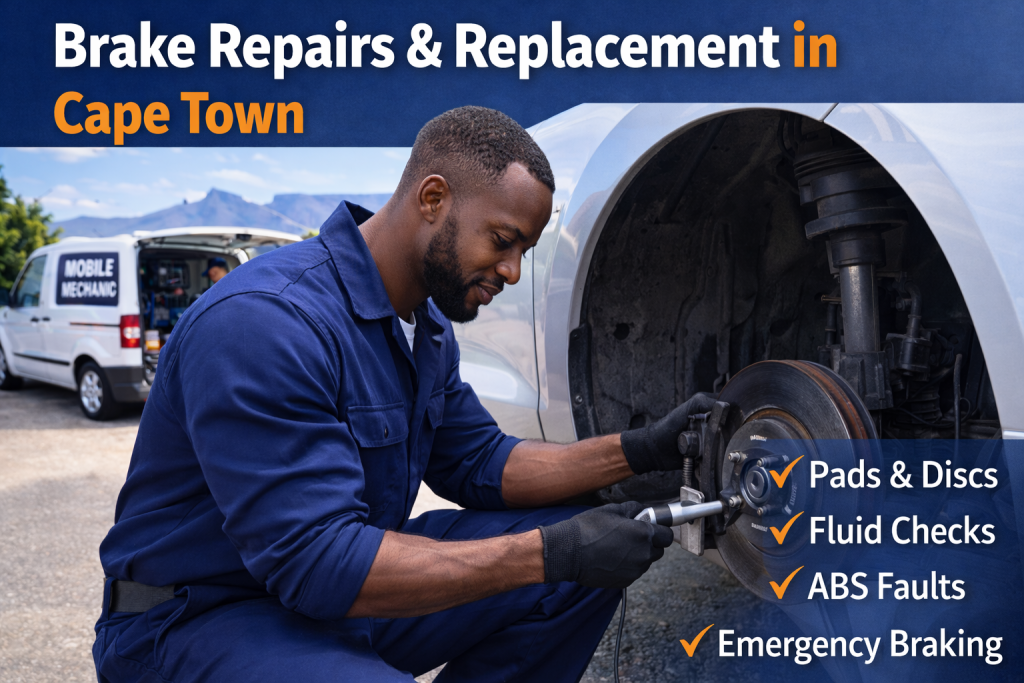
Are your brakes making noise, vibrating, or feeling less responsive? Our professional brake repairs and replacement services in Cape Town ensure your vehicle stops safely and reliably. We provide on-site brake inspections, pad and disc replacements, and fault diagnosis at your home, workplace, or roadside.
Driving with worn or faulty brakes is dangerous. Our mobile mechanics in Cape Town respond quickly to assess braking systems and carry out necessary repairs before minor issues become major safety risks.
Common Brake Problems We Fix
- Squealing or grinding brake noises
- Soft or spongy brake pedal
- Vibration when braking
- Brake warning lights
- Worn brake pads and discs
- Brake fluid leaks
- Uneven braking or pulling to one side
Our Mobile Brake Services in Cape Town
Our mobile brake repair service includes:
- Brake pad replacement
- Brake disc and rotor replacement
- Brake fluid checks and bleeding
- Caliper inspections and servicing
- ABS fault scanning and diagnosis
- Safety inspections and roadworthiness preparation
Related Mobile Mechanic Services
Your braking system often links to other mechanical and electronic components. We also provide:
- Car Diagnostics & Fault Finding in Cape Town
- Emergency Mobile Mechanic in Cape Town
- Battery Replacement & Jump Starts
- Alternator & Starter Repairs
- Minor & Major Car Servicing
Brake Repairs Across Cape Town
We provide mobile brake repairs and replacement across Cape Town, including:
- Bellville
- Parow
- Brackenfell
- Durbanville
- Goodwood
- Cape Town CBD
- Northern Suburbs
Book Brake Repairs in Cape Town
If you need fast, professional brake repairs in Cape Town, contact our mobile mechanics for safe, reliable service at your location.
💬 WhatsApp for Brake Repairs
📞 Call for Immediate Assistance
Brake warning right now? Safety-first advice
If your brake pedal suddenly goes soft, your car pulls hard to one side, you hear grinding metal-on-metal,
or the brake warning light comes on with a noticeable change in braking — avoid driving further if possible.
WhatsApp us your area and the symptoms for quick guidance.
Why brakes wear out (and why symptoms get worse fast)
Brake systems are designed to wear gradually, but once pads get thin or discs develop hotspots,
the braking feel can change quickly. Cape Town driving often includes stop-start traffic,
downhill routes, wet winter conditions, and longer commuting distances — all of which can speed up wear.
Stop-start traffic
More braking events = faster pad wear, especially on heavier vehicles.
Heat buildup
Repeated braking can overheat pads/discs and cause vibration or fade.
Wet weather
Water can reduce bite temporarily and accelerate rust on unused vehicles.
Old brake fluid
Moisture in fluid can lead to a softer pedal and reduced performance.
Brake pads vs discs vs fluid: what your symptoms usually mean
Likely brake pads
- Squealing under light braking
- Longer stopping distance (gradual)
- Brake dust increase on wheels
- Wear indicator noise (high-pitched)
Likely brake discs/rotors
- Vibration / shudder while braking
- Pulsation through the pedal
- Grinding if pads are fully worn
- Uneven braking feel left vs right
Likely brake fluid / hydraulics
- Soft or spongy pedal
- Pedal sinks slowly when held
- Fluid level dropping
- Visible leak near wheel/under car
These are common patterns, but the safe route is a proper inspection. We check the full braking system
and advise what’s required before any work starts.
How our mobile brake inspection works
Our approach is simple: confirm what’s worn, confirm what’s safe, and prevent repeat issues.
We’ll explain what we find in plain language and give you clear options.
- Symptom check: noise, vibration, pulling, warning lights, pedal feel.
- Visual inspection: pads, discs/rotors, calipers, hoses and potential leaks.
- Brake fluid check: level and condition, and whether bleeding is required.
- ABS scan (if needed): fault codes and sensor/ABS-related guidance.
- Quote before work: you approve before any replacements.
If your dash has multiple warning lights or the car is behaving unpredictably, start with
car diagnostics & fault finding
so we can link the symptoms correctly.
FAQs
Is it safe to drive with squealing brakes?
Squealing often means pads are worn or glazed. It may still stop, but wear can accelerate quickly.
Book an inspection to avoid grinding and disc damage.
Why do my brakes vibrate when I stop?
Vibration usually points to disc/rotor issues (hotspots/warping) or uneven pad contact.
An inspection confirms whether discs need replacement.
What does a soft/spongy pedal mean?
Often brake fluid condition, air in the lines, or a leak. If the pedal suddenly changes,
avoid driving and WhatsApp us for guidance.
Can ABS lights be fixed with brake repairs?
Sometimes. ABS lights may be sensor-related. We can scan faults and advise the correct next step.
WhatsApp your area + car make/model + symptoms (noise, vibration, soft pedal, warning light).
If possible, include a short video of the sound — it helps us advise faster.
Brake noises, vibration and warning lights: what to do next
When brakes start making noise, many drivers hope it “goes away”. The problem is that brake issues usually get worse fast.
A light squeal can turn into grinding, and grinding can damage the discs/rotors. That often pushes the repair cost up, and it increases
stopping distance — especially in stop-start Cape Town traffic.
If your vehicle pulls to one side when braking, the pedal suddenly feels soft, or you notice a big change in braking performance,
it’s best to avoid driving further and get it checked. If it’s urgent, use our
Emergency Mobile Mechanic in Cape Town
page for faster assistance.
Common brake symptoms and what they often mean
- Squealing: often worn pads, glazed pads, or dust buildup — worth inspecting before it becomes grinding.
- Grinding: usually pads are fully worn and metal is contacting the disc — stop driving if possible.
- Vibration/shudder: can point to disc/rotor hotspots or uneven braking surfaces.
- Soft/spongy pedal: can indicate old fluid, air in the lines, or a leak — treat this as urgent.
- Brake warning light / ABS light: can be braking system or sensor related — a quick scan helps confirm.
Why early inspection saves money
Brake repairs are usually cheapest when caught early. Replacing pads before they’re completely worn can help protect discs/rotors.
Also, small issues like a loose component, uneven wear, or low fluid are sometimes the reason a brake system feels “wrong”.
A proper inspection helps you avoid replacing parts that aren’t actually the problem.
Our mobile brake check (simple and clear)
We keep this process straightforward. First we confirm the symptom (noise, vibration, pulling, warning lights), then we inspect the braking
components and advise what’s needed. If a wider electrical issue is suspected, we may recommend starting with:
Car Diagnostics & Fault Finding in Cape Town.
- Visual check of pads, discs/rotors, calipers and brake lines
- Brake fluid level/condition check and leak signs
- Advice on what’s safe to drive and what needs urgent attention
- Quote guidance before any replacements are done
After brake repairs: how to keep brakes lasting longer
Brake lifespan depends on driving style and conditions. Avoid riding the brakes downhill, keep tyres correctly inflated, and don’t ignore
early squeals. If your vehicle is due for maintenance, a routine service can help prevent repeat issues — see
Minor & Major Car Servicing.