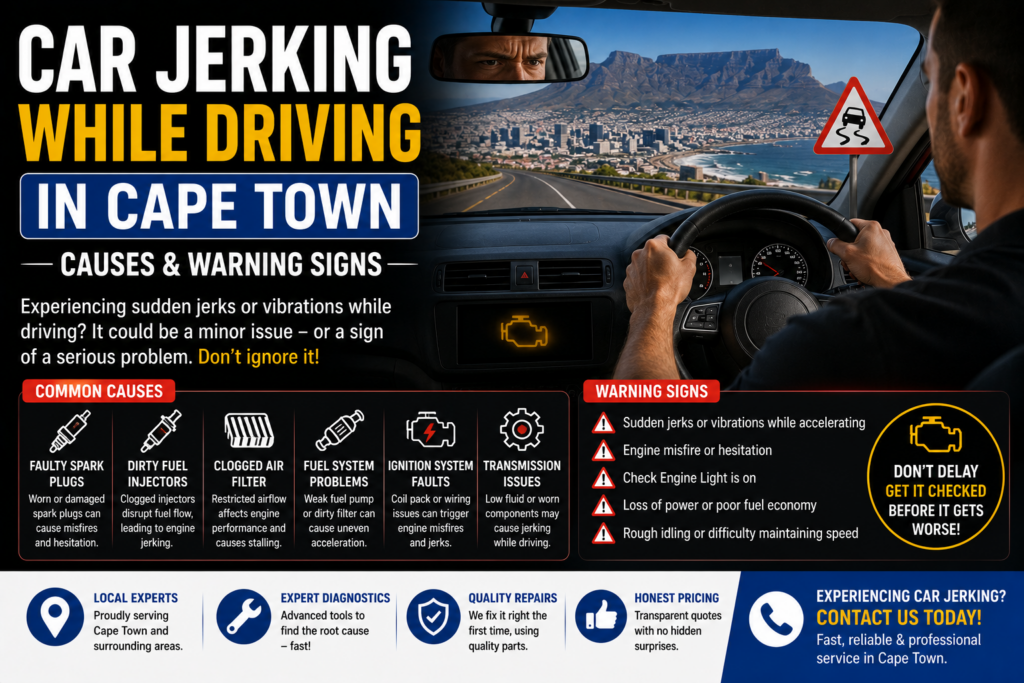
Car Jerking While Driving in Cape Town – Causes & Warning Signs
If your car jerks, hesitates, surges, or feels unstable while driving, it usually means the engine, fuel system, ignition system, transmission, or sensors are not working smoothly. Here’s what causes jerking while driving and when you should get help.
A car that jerks while driving can quickly become frustrating and unsafe. The movement may feel like the vehicle is pulling forward and back, hesitating when you press the accelerator, or suddenly surging without smooth power delivery.
Some jerking problems happen only when accelerating, while others happen at low speed, high speed, when changing gears, or when the engine is cold. The timing of the jerk is important because it helps identify whether the problem is fuel-related, ignition-related, transmission-related, or caused by engine management faults.
At Cape Town Mobile Mechanic, we diagnose jerking, hesitation, misfiring, power loss, and rough running issues on-site across Cape Town.
What Does Car Jerking Feel Like?
Drivers describe jerking in different ways. Some say the car feels like it is “jumping” forward, while others notice hesitation, uneven acceleration, rough gear changes, or shaking from the engine bay.
Common signs include:
- Jerking when accelerating
- Hesitation when pressing the accelerator
- Vehicle surging forward unexpectedly
- Engine shaking or rough running
- Loss of power while driving
- Car jerks when changing gears
- Check engine light appearing
- Poor fuel economy
If the jerking becomes worse over time, it should not be ignored. What starts as a small hesitation can turn into stalling, misfiring, or a complete breakdown.
1. Fuel Delivery Problems
One of the most common causes of jerking while driving is inconsistent fuel delivery. Your engine needs a steady supply of fuel at the correct pressure. If fuel delivery is interrupted, the vehicle may hesitate, jerk, or lose power.
This can happen when the fuel pump is weak, the fuel filter is blocked, or the injectors are dirty. When you accelerate, the engine demands more fuel. If the fuel system cannot keep up, the car may jerk or feel like it is struggling to respond.
- Weak fuel pump
- Blocked fuel filter
- Dirty fuel injectors
- Low fuel pressure
- Contaminated fuel
Fuel-related jerking is often linked to high fuel consumption, rough idling, poor acceleration, and engine hesitation.
2. Spark Plug or Ignition Coil Faults
The ignition system is responsible for burning the fuel-air mixture inside the engine. If spark plugs are worn or ignition coils are weak, combustion becomes uneven. This can cause the engine to misfire, shake, or jerk while driving.
Ignition faults often become more noticeable when accelerating, driving uphill, or placing the engine under load. The vehicle may feel like it is cutting in and out because one or more cylinders are not firing properly.
Common ignition-related symptoms include:
- Engine misfire
- Car jerks during acceleration
- Rough idle
- Reduced power
- Flashing check engine light
- Fuel smell from exhaust
If your vehicle is shaking or misfiring, read our guide on engine misfire symptoms in Cape Town.
3. Air Intake and Sensor Problems
Modern vehicles rely on sensors to calculate how much fuel should be delivered based on airflow, throttle position, engine temperature, and exhaust readings. If a sensor sends incorrect information, the engine may run too rich or too lean.
When the air-fuel mixture is wrong, the vehicle may jerk, hesitate, surge, or lose power. A dirty mass air flow sensor, vacuum leak, faulty oxygen sensor, or dirty throttle body can all affect smooth driving.
- Dirty mass air flow sensor
- Faulty oxygen sensor
- Vacuum leaks
- Dirty throttle body
- Faulty throttle position sensor
- Air intake leaks
These faults often trigger a check engine light and require proper diagnostics to confirm the cause.
4. Transmission or Gearbox Problems
If the jerking happens during gear changes, the issue may be related to the transmission rather than the engine. Automatic transmissions may jerk when shifting if there is low transmission fluid, worn internal components, faulty solenoids, or control module issues.
Manual vehicles may jerk if the clutch is worn, the driver feels vibration during take-off, or the vehicle struggles to transfer power smoothly from the engine to the wheels.
Transmission-related warning signs include:
- Jerking between gears
- Delayed gear engagement
- High revs before movement
- Transmission slipping
- Burning smell
- Shuddering during acceleration
Transmission problems should be checked early because continued driving can increase repair costs significantly.
Why Jerking Problems Are Common in Cape Town
Cape Town driving conditions can expose jerking problems quickly. Stop-start traffic, short trips, steep roads, coastal moisture, and long commuting routes all place extra stress on engine, ignition, fuel, and transmission systems.
Short trips can prevent the engine from reaching full operating temperature regularly. This may contribute to carbon buildup, weak battery charging, poor fuel economy, and rough engine performance. In heavy traffic, small faults become more noticeable because the car is constantly accelerating, slowing down, and idling.
Coastal moisture can also affect electrical connectors, sensors, and ignition components, especially in older vehicles or cars parked outdoors.
When You Should Stop Driving Immediately
A small jerk may not seem serious at first, but severe jerking can be dangerous. You should stop driving and get assistance if the vehicle feels unsafe or the symptoms suddenly get worse.
- The car jerks violently
- The check engine light flashes
- The vehicle loses power suddenly
- The engine stalls or cuts out
- You smell fuel or burning
- The transmission slips badly
- The vehicle struggles to accelerate in traffic
If the car becomes unsafe to drive, use an emergency mobile mechanic in Cape Town rather than forcing the vehicle further.
How We Diagnose Car Jerking Problems
Jerking problems should never be diagnosed by guessing because many faults can create similar symptoms. Replacing spark plugs, sensors, or fuel parts without testing can become expensive if the actual cause is elsewhere.
Our diagnostic process may include:
- OBD diagnostic scanning
- Live sensor data analysis
- Fuel pressure testing
- Spark plug and ignition coil inspection
- Air intake and vacuum leak inspection
- Transmission behaviour checks
- Road testing where safe and necessary
A proper car diagnostics service in Cape Town helps identify whether the issue is fuel-related, ignition-related, sensor-related, transmission-related, or engine-related.
Problems Often Linked to Car Jerking
Jerking while driving often appears with other symptoms. These related issues can help identify the root cause faster.
Looking at all symptoms together helps avoid misdiagnosis and improves repair accuracy.
Is Car Jerking Expensive to Fix?
The cost depends on what is causing the jerking. Some fixes are relatively simple, such as replacing worn spark plugs, cleaning a throttle body, or replacing a blocked filter. Other causes may involve fuel injectors, sensors, transmission faults, or deeper engine issues.
The key is early diagnosis. Early diagnosis is important because small faults often become much larger repairs. An untreated engine misfire can damage the catalytic converter, while fuel system problems may lead to stalling, hesitation, and reduced performance. Transmission faults can also deteriorate quickly, resulting in significantly higher repair costs if left unresolved.
Getting the problem checked early usually prevents additional damage and helps keep repair costs lower.
Related Mobile Mechanic Services
If you experience similar jerking or hesitation issues inland, you can also view our Bloemfontein mobile mechanic services.
Car Jerking While Driving? Get It Diagnosed
We diagnose jerking, hesitation, misfiring, poor acceleration, and rough running problems anywhere in Cape Town.
Frequently Asked Questions
Why does my car jerk when accelerating?
Jerking during acceleration is often caused by fuel delivery problems, ignition faults, dirty sensors, air intake issues, or transmission problems.
Can bad spark plugs cause jerking?
Yes. Worn spark plugs or faulty ignition coils can cause engine misfires, which often feel like jerking or hesitation while driving.
Is it safe to drive if my car is jerking?
Mild jerking may not be dangerous immediately, but severe jerking, power loss, stalling, or a flashing check engine light means you should stop driving and get help.
Can dirty fuel injectors cause jerking?
Yes. Dirty or blocked injectors can interrupt fuel delivery and cause rough running, hesitation, jerking, or poor acceleration.
Can a mobile mechanic diagnose jerking problems?
Yes. Most jerking, hesitation, misfire, and sensor-related problems can be diagnosed on-site with proper testing.