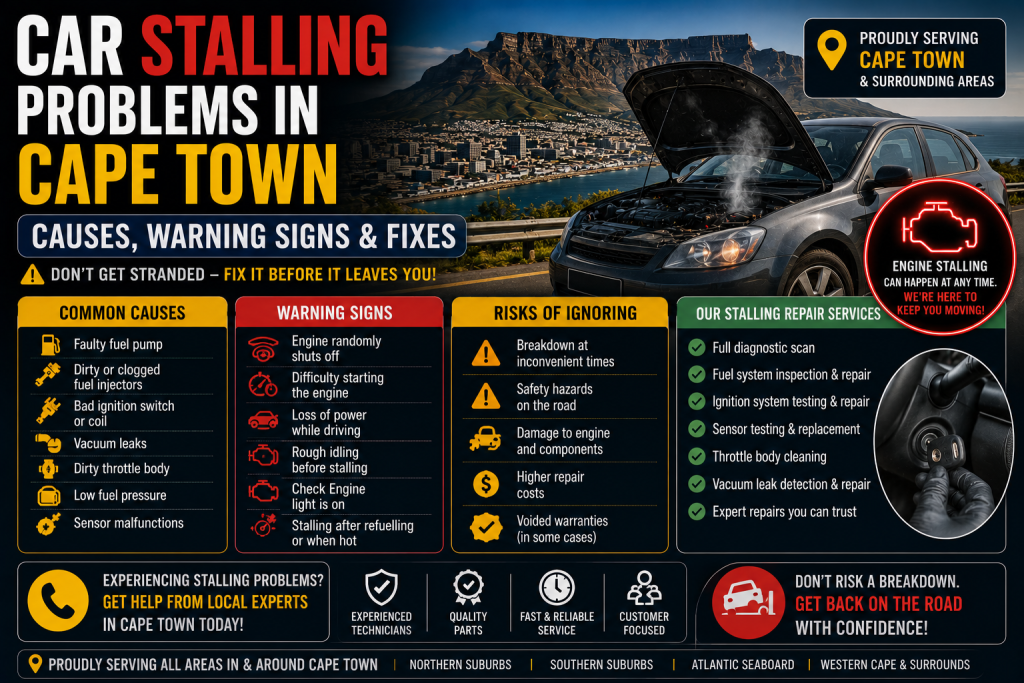
Car Stalling Problems in Cape Town – Causes, Warning Signs & Fixes
If your car stalls at traffic lights, cuts out while driving, or switches off when idling, it is a warning sign that something needs attention. Here’s what causes stalling and when to stop driving.
A car that stalls unexpectedly can be frustrating, stressful, and dangerous. In Cape Town traffic, a vehicle that cuts out at an intersection, in a parking area, or while moving slowly can quickly create a safety risk. Even if the car restarts afterwards, the problem should not be ignored.
Stalling usually means the engine is not receiving the correct balance of fuel, air, spark, or electrical control. In some vehicles, the issue may only happen when the engine is cold. In others, it may happen after the engine warms up, when braking, while idling, or when pulling away.
At Cape Town Mobile Mechanic, we diagnose stalling problems on-site and identify the root cause before unnecessary parts are replaced.
Common Signs of a Stalling Problem
Stalling does not always happen the same way. Some vehicles shut off suddenly with no warning, while others give clear symptoms before cutting out. Paying attention to these signs helps narrow down the cause.
- Engine cuts out when idling
- Car stalls at traffic lights or stop streets
- Vehicle switches off when slowing down
- Engine starts again after a few minutes
- Rough idle before stalling
- Check engine light appears
- Loss of power before the engine dies
If the stalling happens more than once, the vehicle needs proper inspection. Repeated stalling often becomes worse over time and may eventually leave you unable to restart the car.
1. Fuel Delivery Problems
The engine needs a steady supply of fuel to keep running. If the fuel pump is weak, the fuel filter is blocked, or the injectors are dirty, the engine may not receive enough fuel. When that happens, the car can hesitate, lose power, or stall completely.
Fuel delivery problems often become noticeable when accelerating, driving uphill, or pulling away from a stop. In some cases, the vehicle may start normally but stall once demand increases.
- Weak fuel pump
- Blocked fuel filter
- Dirty fuel injectors
- Low fuel pressure
- Contaminated fuel
If your vehicle also uses more fuel than normal, read our guide on high fuel consumption in Cape Town.
2. Idle Control and Air Intake Issues
Many stalling problems happen when the car is idling. This is common at traffic lights, stop streets, parking lots, or when reversing slowly. At idle, the engine needs very precise air control to keep running smoothly.
If the throttle body is dirty, an idle control valve is faulty, or there is an air leak, the engine may not maintain a steady idle. The revs may drop too low, causing the car to shake and switch off.
- Dirty throttle body
- Vacuum leaks
- Faulty idle control valve
- Air intake leaks
- Incorrect sensor readings
These problems can also cause rough idling, poor acceleration, and engine hesitation. They should be diagnosed properly instead of cleaned or replaced blindly.
3. Ignition System Faults
The ignition system creates the spark needed to burn fuel inside the engine. If the spark is weak or inconsistent, the engine may misfire, run roughly, lose power, or stall.
Common ignition-related causes include worn spark plugs, faulty ignition coils, damaged leads, or poor electrical connections. These problems may appear worse when the engine is under load or when accelerating from low speed.
If the car shakes, jerks, or runs unevenly before cutting out, the stalling may be linked to an engine misfire.
4. Sensor or Electrical Problems
Modern vehicles rely on sensors to control fuel delivery, ignition timing, air intake, and idle speed. If a sensor fails or sends incorrect information, the engine control unit may make the wrong adjustments.
Sensors that can contribute to stalling include the crankshaft position sensor, camshaft position sensor, mass air flow sensor, oxygen sensor, and coolant temperature sensor. A failing crankshaft sensor is especially important because it can cause the engine to cut out suddenly and restart later.
Electrical problems may also cause intermittent stalling. Loose connections, weak battery voltage, alternator problems, or damaged wiring can interrupt engine control systems. If your car has warning lights or electrical symptoms, a proper car diagnostics check in Cape Town is the safest starting point.
Why Stalling Happens Often in Cape Town Driving Conditions
Cape Town traffic can make stalling problems more noticeable. Stop-start driving, steep roads in some areas, short trips, and long idle times all place extra demand on the fuel, ignition, and idle control systems.
A vehicle that feels fine on an open road may stall repeatedly in slow city traffic because the engine spends more time idling and operating at low speeds. Coastal moisture can also affect electrical connections, especially in older vehicles or cars parked outdoors.
This is why intermittent stalling should not be dismissed. The problem may only appear in certain conditions, but that does not mean it is harmless.
When You Should Stop Driving Immediately
A car that stalls once may restart and continue driving, but repeated stalling is a safety concern. You should stop driving and get help if the vehicle cuts out while moving or becomes difficult to control.
- The engine stalls while driving
- The car loses steering or braking assistance
- The engine cuts out at intersections
- The vehicle will not restart reliably
- The check engine light flashes
- You smell fuel or burning
If the vehicle is unsafe to drive, contact an emergency mobile mechanic in Cape Town instead of forcing the car further.
How We Diagnose Car Stalling Problems
Stalling problems require a structured diagnostic process because many faults create similar symptoms. Guessing usually leads to unnecessary parts being replaced while the real problem remains.
Our inspection may include:
- Diagnostic scan for fault codes
- Live sensor data checks
- Fuel pressure testing
- Throttle body and air intake inspection
- Spark plug and ignition coil checks
- Battery and alternator testing
- Road testing where safe and necessary
This process helps determine whether the fault is caused by fuel delivery, air intake, ignition, electrical supply, sensors, or engine management.
Is a Stalling Problem Expensive to Fix?
The cost depends on the cause. Some stalling problems are relatively simple, such as a dirty throttle body, weak battery, or overdue service item. Other causes, such as fuel pump failure, sensor faults, or wiring issues, may require more detailed testing and repair.
The biggest cost risk comes from delaying the repair. A small misfire, sensor issue, or fuel problem can affect other parts over time. It can also leave you stranded if the car eventually refuses to restart.
Early diagnosis is usually the most affordable approach because it prevents repeat breakdowns and avoids replacing parts unnecessarily.
How to Reduce the Risk of Your Car Stalling
Although not every stalling problem can be prevented, regular maintenance reduces the risk significantly. A vehicle that receives timely servicing is less likely to develop fuel, ignition, air intake, and battery-related issues.
- Service the vehicle on schedule
- Replace spark plugs when required
- Keep the air filter clean
- Fix warning lights early
- Check battery and alternator health
- Investigate rough idling before it gets worse
Routine car servicing in Cape Town helps keep the engine running smoothly and reduces the chance of unexpected stalling.
Related Problems Often Linked to Stalling
A stalling vehicle often shows other symptoms before it cuts out completely. These related issues can help identify the root cause faster.
Related Mobile Mechanic Services
If you experience similar stalling problems inland, you can also view our Bloemfontein mobile mechanic services.
Car Stalling or Cutting Out? Get It Checked
We diagnose stalling, rough idle, fuel delivery, ignition, and sensor problems at your location anywhere in Cape Town.
Frequently Asked Questions
Why does my car stall when idling?
This is often caused by idle control problems, air intake issues, a dirty throttle body, sensor faults, or fuel delivery problems.
Why does my car cut out while driving?
A vehicle that cuts out while driving may have fuel pump problems, ignition faults, crankshaft sensor issues, electrical faults, or engine management problems.
Is it safe to keep driving if my car stalls?
If the car stalls repeatedly or cuts out while moving, it is not safe to keep driving. You should have it inspected as soon as possible.
Can a weak battery cause stalling?
Yes, weak voltage or charging system problems can affect engine management and electrical systems, especially in modern vehicles.
Can a mobile mechanic fix a stalling problem?
Yes. Most stalling problems can be diagnosed on-site, and many can be repaired at your location depending on the cause.